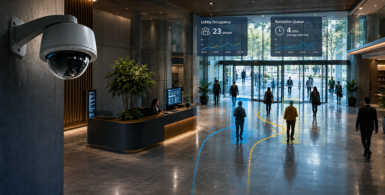
Vaidio now supports SIA DC-09 for direct alarm transmission to control rooms
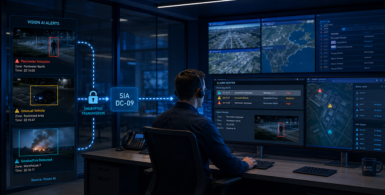
VAIBS now supports the SIA DC-09 protocol within Vaidio. This allows alarm notifications generated by the Vision AI platform to…

On (rural) roads in the Netherlands, wildlife has been a serious risk to road safety for years. Collisions lead to damage, delays, and unfortunately sometimes injuries. At the same time, the issue also has an ecological impact: animals that can no longer safely cross roads become cut off from their habitat, with consequences for biodiversity.
For ProWild, this was a reason to look beyond traditional warning systems. The question was not only how animals can be detected earlier, but especially how that information can be translated quickly into a concrete warning for road users.
From this challenge, AISecure360 was developed: a solution where detection, camera technology, AI video analytics, and traffic control come together in one operational chain. This is exactly what makes the innovation interesting. It’s not about a single product, but about how different technologies strengthen each other.
Gert Hamberg of ProWild: “Wildlife collisions are a structural problem, resulting not only in material damage but also posing risks to drivers, passengers, and biodiversity. Driven by this urgency, ProWild looked for a solution that can detect early, assess reliably, and only act when necessary. The challenge was not simply detection, but building a system that is truly usable in practice.”
Within AISecure360, the process starts with radar technology from Magos Systems, which detects movement near the road. Once something relevant is detected, a Predator PTZ camera from 360 Vision Technology takes over. It automatically zooms in on the object and tracks it, ensuring clear and usable footage for further analysis.
Next, Vaidio comes into play, the AI Video Analytics platform from VAIBS. Vaidio analyzes in real time what is happening, determines whether it poses a relevant risk, and provides the intelligence needed to automatically trigger roadside warning systems for drivers. If required, additional follow-up actions can also be initiated.
What makes this setup powerful is that the technologies do not operate separately, but truly extend one another. Andy Payne of Magos Systems highlights this: “Effective detection requires reliable performance under varying conditions, but the project only becomes truly powerful when radar, camera, and analytics work together as one. That’s exactly what this innovation is about. The radar detects something, the camera visualizes it, Vaidio understands it, and the traffic system translates that into action on the road.”
The role of the camera goes beyond simply capturing images. Roadside environments are rarely ideal: darkness, backlight, rain, and long distances demand a system that consistently delivers usable footage. The Predator camera plays a key role in this.
Adrian Kirk of 360 Vision Technology emphasizes the importance of image quality for accurate analysis: “When software needs to determine what it sees, everything starts with reliable imagery. Thanks to powerful optical zoom and strong low-light performance, that reliability is achieved—even in locations where conventional systems would require more infrastructure. This not only offers technical advantages but also makes the solution more practical and efficient to deploy along roads.”
Vaidio’s role in this ecosystem is particularly interesting because it does not function as a standalone product, but as a connecting layer between existing technologies. In this use case, Vaidio demonstrates what integration means in practice: building on what is already there and adding intelligence. The radar provides a trigger, the camera adds context, and the traffic infrastructure awaits a signal. Vaidio brings these elements together into one operational system. As a result, the solution not only detects, but also classifies, interprets, and acts. 
Jos Stijkel, International Business Development Manager at VAIBS, highlights that the solution’s applicability extends far beyond wildlife detection: “This collaboration is extremely powerful and is already proving itself along highways in the Netherlands. At the same time, there are many more locations where this solution adds value. In areas requiring enhanced security, a large perimeter can be covered with minimal installation effort. Radars can reach up to 1,000 meters, as can the cameras. But seeing alone is not enough—you need to determine whether something is actually a risk.
This is why the solution is also highly relevant for other critical infrastructures, such as energy facilities, airports, railways, ports, and logistics centers. The strength of Vaidio is that it can also be deployed directly on existing camera networks, without additional installation work. This enables faster understanding of the scale and nature of potential risks.
While this example focuses on animals near roads, the possibilities in other environments are equally valuable. Think of instantly identifying whether a vehicle or license plate has been seen before across one or multiple locations. Or quickly retracing where a person has been, and even estimating their current location after they have moved out of camera range.”
The value of this collaboration goes beyond real-time alerts. The latest generation of AISecure360 builds on a system that has been active since 2011. During that time, more than 1,600 collisions have been prevented, damage has been reduced by over 90%, and approximately eight million euros in costs have been saved.
These figures clearly demonstrate the practical impact of the system, but there is also a second benefit. By classifying animals and systematically recording events, a valuable dataset is created on species, locations, and movement patterns. Where manual field research was once required, a much richer and more continuous insight is now generated automatically. As a result, the solution not only improves road safety but also contributes to better understanding of biodiversity.