


How to Turn Visual Data into a Strategic AI Advantage
AI is developing at an incredible pace. New models, copilots and agents are becoming increasingly powerful. Almost every organisation is…

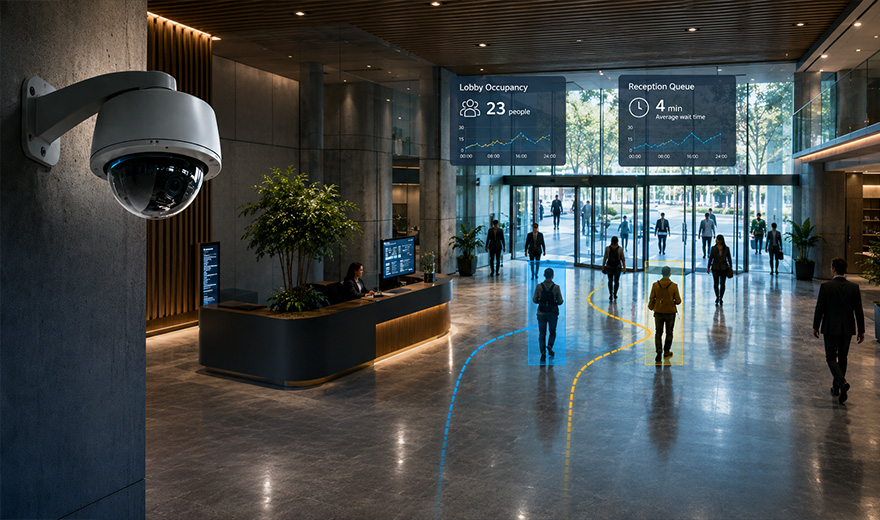
Security cameras are primarily used to protect people, buildings and sites. They record and detect incidents, provide security teams with visibility across a location and support investigations after an event. However, the same cameras can provide much more valuable information.
With Vision AI, video footage can be transformed into usable data about visitor numbers, occupancy, queues, walking routes, dwell time and the use of spaces. As a result, a camera system becomes more than a security solution. It also becomes a valuable source of operational intelligence.
In this article, we explain how this works.
A conventional camera records what happens. Without additional analytics, users still need to watch and interpret the footage themselves. Vision AI adds an intelligent analytics layer. It can recognise people, vehicles and objects and analyse how they move through an environment.
Video footage can therefore be converted into measurable information, including:
This information can be displayed in dashboards, reports or connected business systems. Organisations gain insight into what is happening right now, as well as how locations and processes develop over time.
Many organisations already have extensive camera networks. Cameras are installed at entrances, in car parks, inside shops, on factory floors or alongside roads. Separate sensors are often installed for operational measurements, such as people counters, motion sensors or queue-monitoring systems. Vision AI can extract part of this information from existing camera footage, reducing the need to install new hardware for every individual use case.
The same camera can also support several purposes. A camera at an entrance can be used for security, visitor counting, occupancy measurements and analysing peak periods. A camera overlooking a car park can detect suspicious situations, count vehicles and collect information about occupancy and dwell time. This significantly increases the value and versatility of existing camera infrastructure.
Below, we highlight several practical use cases.
A common Vision AI application is the analysis of visitor flows.
The technology can measure how many people enter, leave or pass a location. It can also analyse how visitors move through a building, shop or site.
This provides answers to questions such as:
For retailers, this can provide insight into how different areas of a store are used. Hospitals can improve the organisation of waiting areas and visitor flows. At airports, railway stations and event venues, this information can support crowd management and capacity planning.
Knowing how many people enter a location is often not enough. The greatest value is created when different measurements are combined.
A retailer can, for example, gain insight into:
This creates a clearer picture of conversion between different stages of the customer journey. When many people enter a store but relatively few proceed to the checkout, this may be a reason to examine the store layout, product range, presentation or staffing levels. Vision AI does not automatically determine why something happens. It does reveal patterns that would otherwise be difficult to measure objectively. This provides managers with a stronger basis for further analysis and decision-making.
A busy area is not necessarily a valuable area. In addition to visitor numbers, it is therefore important to examine how long people remain in specific locations. Dwell-time analytics measure how long people stay within a defined zone. Heatmaps show where visitors frequently walk, stop or spend more time.
This can help organisations determine:
By comparing measurements before and after a change, organisations can objectively assess the impact of a refurbishment, campaign or redesigned layout.
Queues directly affect both customer experience and operational efficiency. Vision AI can determine how many people are waiting and how long they remain in a queue. When a predefined threshold is exceeded, the system can automatically send an alert.
A supermarket can, for example, receive a notification when a checkout queue becomes too long. A hospital can identify when a waiting area is becoming busier than usual. At a logistics site, the system can detect when vehicles are building up near a loading or unloading zone. Historical data can also support staffing and capacity planning. When peaks repeatedly occur at the same times, an organisation can plan for them in advance.
Operational video analytics are not limited to locations with large visitor numbers. Within logistics and industrial environments, cameras can provide insight into vehicles, goods flows and the use of sites.
Possible applications include:
This makes it possible to identify operational bottlenecks that may only become visible much later in conventional reports.
Vision AI helps organisations respond immediately while also supporting long-term process improvement. Real-time analytics can automatically send an alert when a situation requires attention. This may happen when an area becomes too crowded, an access route is blocked or a queue exceeds a predefined length. Historical analytics reveal trends and recurring patterns. Organisations can compare different days, times, sites and branches. This makes it possible to assess the effects of a different staffing schedule, a redesigned environment or a new working method. Real-time alerts support day-to-day operations. Historical insights provide a stronger basis for tactical and strategic decisions.
Privacy is not an afterthought. It is a core principle when deploying Vision AI. For most operational analytics, there is no need to identify individuals. The technology focuses on numbers, movement, dwell time and patterns rather than a person’s identity. Where required, people can be automatically blurred and only anonymised metadata can be stored. User permissions, retention periods and access to footage can also be carefully restricted. Before starting an analysis, organisations determine its purpose, which information is genuinely required and who may access it. This keeps data processing focused, proportionate and controllable.


