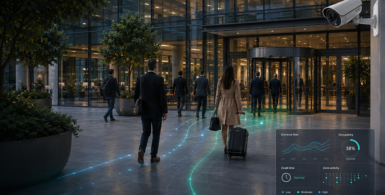
Critical infrastructure needs more than cameras that record
Recent incidents in the Netherlands and Germany once again show how vulnerable critical infrastructure can be. And they raise an…


Caring for older people with dementia poses specific challenges, especially in terms of freedom of movement and safety. Care homes strive to strike a balance between providing freedom and ensuring safety for this vulnerable group. A common problem is managing ‘living circles’-areas in which clients are allowed to move freely. Traditional methods often fall short of effectively monitoring and maintaining these living circles. Facial recognition offers a solution to this problem. But what is allowed and what is not allowed in terms of facial recognition? In this article, we cover the possibilities of this technology for healthcare.
But before we delve further into the application of face recognition, let’s look at the concept itself.
Face recognition is a form of biometric technology that uses artificial intelligence (AI) to automatically recognise and identify people’s faces. This involves analysing an image of a face – captured via a camera – for unique features, such as eye distance, nose shape, jawline and other geometric patterns in the face.
These unique features are converted into a digital ‘template’, a mathematical representation of the face. When a person is in front of a camera again, his or her face is compared with the templates stored in a secure database. If a match is found, the system can recognise the person and associate appropriate actions with them-such as opening a door or recording presence.
The use of facial recognition raises concerns about privacy and ethics. Processing biometric data, such as facial images, is considered by the General Data Protection Regulation (GDPR) as processing special personal data and is in principle prohibited, unless a legal exception applies. One of the exceptions is when data subjects have given explicit consent to the processing of their biometric data. Another exception is when the processing is necessary for authentication or security purposes, provided there is a compelling public interest. It is essential that healthcare institutions handle this data carefully and are transparent about its use. This includes fully informing clients and their representatives and obtaining explicit consent. In addition, the data should be stored securely and used only for its intended purpose.
A crucial step in this process is carrying out a Data Protection Impact Assessment (DPIA). This is a mandatory risk assessment for processing operations that are likely to pose a high privacy risk-such as facial recognition. A DPIA describes what data is collected, for what purpose, how it is protected, and the risks to data subjects. It also includes measures to mitigate those risks. Without a thorough DPIA, facial recognition should not be used within healthcare institutions.
In addition to the AVG, the Wet zorg en dwang (Wzd) relevant. This law regulates the rights of people with intellectual disabilities and people with psychogeriatric conditions (such as dementia) who receive involuntary care. The core of the Wzd is ‘No, unless’, meaning that involuntary care may only be applied if there is no other way. The use of facial recognition must be in line with this legislation, with the welfare and rights of the client at its core.
Within healthcare facilities working with living circles, facial recognition can play an important role in automatically enforcing these boundaries.
Each client is assigned a living circle based on his or her care plan. This may mean, for example, that a person is free to move around within the ward, but access to the outside door or other wards is restricted. Facial recognition technology is linked to cameras placed at strategic points, such as at doors to the outside or to other wards.
When a person is in front of a door, the camera records the face and compares it with the existing face profiles in the secure database. If the person is in the database and should not have access to the relevant area according to the care plan, the door will remain closed. If the person is not in the database, the door will open automatically. Of course, different dependencies can be set in this process. For example: if there are two people in front of a door, where one person does and one person does not have access to a certain area, the door will not open either.
This working method allows for person-centred surveillance without physical intervention or creating the feeling of confinement. For clients, the system feels intuitive and friendly: doors simply open automatically when allowed, and remain closed unnoticed when not.
In addition, the technology can help record movements, for example to understand a client’s movement pattern. This can provide valuable information to the care team, which can closely monitor the client’s wellbeing and make adjustments where necessary.
The Vaidio platform offers healthcare institutions a powerful and AVG-proof solution to conduct person-centred surveillance in a respectful and secure manner. Advanced face recognition via existing IP cameras allows the system to detect, identify faces in real-time and automatically perform actions such as opening doors or sending notifications.
Vaidio stands out for its accuracy, speed and versatility. Multiple faces can be recognised simultaneously, and the system can be linked to access control, alarms or even client route analysis. This allows living circles to be set up and automatically maintained at individual level, without being perceived as restrictive by the client.
With features such as authorised and/or block list recognition, real-time tracking across multiple cameras and the ability to find individuals in hours of video footage within seconds, Vaidio is ideally suited to complex healthcare environments. In doing so, privacy is key: any use of Vaidio is preceded by a mandatory DPIA, and the technology is fully compliant with AVG guidelines.
In short, Vaidio combines security, autonomy and technological innovation into a future-proof solution for modern healthcare facilities.
Although Vaidio is known for its powerful face recognition, the platform’s functionality extends much further. With more than 35 different AI Analytics on board, including aggression detection and fall detection, Vaidio offers a comprehensive video analytics platform that helps healthcare facilities improve the safety, efficiency and well-being of residents and staff. Want to know more about Vaidio? Visit the product page or Contactone of our specialists. They will be happy to provide you all the information.