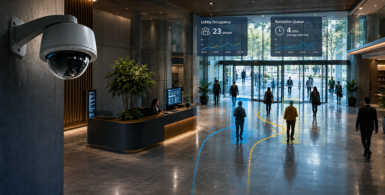
Vaidio now supports SIA DC-09 for direct alarm transmission to control rooms
VAIBS now supports the SIA DC-09 protocol within Vaidio. This allows alarm notifications generated by the Vision AI platform to…
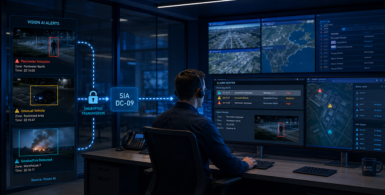

The work of a control room operator can be incredibly intensive. They must always be “on,” constantly observe multiple screens, and act quickly when needed. This requires a tremendous cognitive load. It is therefore entirely realistic that an operator may occasionally miss an incident. In this article, we explore why this is ‘normal’ and how smart AI technology can support operators in their daily work.
Humans are capable of a great deal. Yet there are clear limits to our abilities — we are not superheroes. Our vision, too, has its boundaries. A person with two eyes has a visual field of about 180 degrees. Within that range, only a very small portion—around 2 to 3 degrees—is in sharp focus (Strasburger, Rentschler, & Jüttner, 2011).
Although it may feel like we see everything clearly, we can only perceive a tiny part of our surroundings in detail at any given moment. Research shows that visual acuity drops by up to 50% the further objects move away from the area of focus (Anstis, 1974).
The human brain is trained to recognize patterns and anomalies in the environment. This skill is valuable for operators, but just like our perceptual abilities, our information-processing capacity also has limits. In situations with many screens, the brain can become overwhelmed, leading to:
Missing information: Operators may overlook important details due to distractions, unexpected events (inattentional blindness), or gradual changes (change blindness).
Slower decision-making: A large amount of incoming information quickly fills working memory, making it harder to retrieve relevant details. This slows down decision-making and response time.
Reduced concentration: Over time, information overload leads to high workload, fatigue, and decreased focus.
Do you notice all the changes in this living room video? The human brain struggles to detect small, rapid changes. This same phenomenon occurs in the control room.
As the examples above show, it is actually quite normal for an operator to occasionally miss an incident — no matter how skilled they are. Below, we explain how technology can help.
In modern control rooms, smart technologies already play an important role — from camera management systems to alarm handling tools. When it comes to visual inspection and detection tasks, operators can be supported even further through Video AI Analytics.
Video AI Analytics can analyze all camera feeds in the control room 24/7 to automatically detect anomalies or dangerous situations. This analysis is based on the entire image — not on the 2–3 degrees of sharp focus that the human eye perceives. When an anomaly is detected, Video AI Analytics can generate an alert, enabling operators to act proactively.
This technology has broad capabilities and can support various tasks. Here are a few examples:
Video AI Analytics continuously scans video streams for patterns and irregularities such as:
Video AI Analytics detects anomalies in live footage, enabling immediate intervention.
Using advanced algorithms, Video AI can detect and classify objects, vehicles, or people. For example, in a parking garage, AI can track vehicle movement and trigger an alert when a car parks unlawfully or behaves suspiciously. This allows operators to monitor more purposefully instead of manually watching everything.
By taking over repetitive and automated tasks — such as continuously monitoring camera streams — Video AI Analytics significantly reduces the cognitive burden on operators. This allows them to focus on tasks where human expertise truly matters, such as making complex decisions based on AI insights.
As becomes clear, Video AI Analytics is an extremely useful tool for operators. Naturally, technology does not replace them — events must always be verified by human eyes. Control room work will always require human judgment. However, AI enables operators to work more efficiently, more accurately, and with greater added value.
Introducing AI into the control room requires a holistic shift in the workplace. Changes in equipment, processes, and workflows are necessary to ensure effective collaboration between operators and AI.
Want to learn more about implementing Video AI Analytics in the control room? On Thursday, November 14, we are hosting a webinar together with vhp human performance:
“Smart Video Management in the Control Room – Where humans and technology work together as a team.”
During this webinar, we will discuss:
You can register using the button below. Unable to attend? No problem — all registrants will receive a replay afterward.
We look forward to seeing you on November 14!