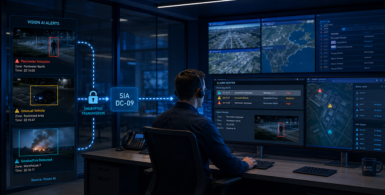
Vaidio now supports SIA DC-09 for direct alarm transmission to control rooms
VAIBS now supports the SIA DC-09 protocol within Vaidio. This allows alarm notifications generated by the Vision AI platform to…

By Henk-Jan Hop, COO at VAIBS.
Last weekend, the Dutch television network RTL focused on the use of AI in shops. The item provoked mixed reactions: smart systems were mainly portrayed as ‘digital eyes’ that monitor customers. This is a sensitive issue, which is understandable. Data-driven technology in public and commercial spaces touches on privacy, trust and feelings of security..
However, something important is often missing from these kinds of discussions: if AI is developed and applied responsibly, it can actually contribute to security, customer experience and integrity, without infringing on privacy.
The reality is that retailers are facing major challenges. Jumbo alone estimates the annual damage caused by theft at over €100 million. On top of that, we are seeing increasing aggression towards staff, incidents at self-scan checkouts, and pressure on margins. Retailers are looking for solutions, and technology can play a role in this.
But then it must be done properly. Transparently, carefully and within clear ethical and legal frameworks..
Let’s start by clearing up an important misunderstanding: AI in retail is not automatically about facial recognition. Modern video AI can detect risks based on behavioural patterns and context — not on who someone is.
Examples:
This helps shops prevent problems, relieve staff and improve the shopping experience.
Without the need for a customer database, profiling or biometric identification.
AI in retail should not be a system that seeks out victims. It should understand situations correctly. The goal is not to control, but to protect. Not to punish, but to prevent.
Surveillance systems are becoming increasingly proactive rather than reactive. Whereas security guards often only intervene when something happens, AI can provide early warning signs. Think of aggression in the making, fire hazards or unwanted escalation. The result: safer shops, fewer incidents and less pressure on staff.
Technology can do a lot, but that doesn’t mean it has to do everything. Strict preconditions are needed:
Privacy by design: collect as little data as possible, store it locally where possible.
No biometrics unless strictly necessary: under legal conditions and with proportionality.
Human control and transparent processes: technology supports, but never decides independently.
Follow the European legal framework: think of the GDPR and the European AI Act.
Clear communication to customers: people need to know why something is happening and what is not happening.
When these principles are applied, a fair system is created that protects customers, supports employees and guarantees the integrity of processes.
We need to move away from the framework that suggests there are only two options:
The reality is a third option: responsible, transparent AI tools that respect dignity and privacy and add value. To achieve this, it is crucial that organisations choose technology partners who take data integrity and ethics seriously. Not just at the end of the project, but from the very first architectural sketch.
If you want to use AI, choose parties that:
Technology can only work if society trusts it. Trust requires responsibility.
What many organisations do not yet realise is that European AI legislation is very clear on this point: responsibility lies not only with the supplier, but also with the user. If a partner or developer of an AI solution does not comply with the European AI Act, the end user or system integrator can be held jointly responsible and, in some cases, even liable to prosecution.
That is precisely why choosing reliable technology partners is no longer an operational choice, but a strategic and legal necessity.
The debate about AI in retail is important. Criticism is healthy. Questions are necessary. But let’s have this conversation based on facts, nuance and social values. Not on fear.
The question is not:
“Should we ban AI in shops?”
The question is:
“How can we use AI in a way that benefits everyone?”
That is what our sector should focus on. Not hype. Not fear. But responsible, people-oriented use of technology. AI does not have to be scary. Irresponsible use of it does. That is where the line is drawn — and where the responsibility lies — with us.
AI will play an important role in the future of retail and security. Let’s ensure that this role is fair, transparent and positive. With technology that supports, not controls, and protects, not spies. The choices we make today will determine how this technology is viewed and used in the future.