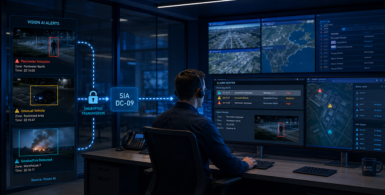
Vaidio now supports SIA DC-09 for direct alarm transmission to control rooms
VAIBS now supports the SIA DC-09 protocol within Vaidio. This allows alarm notifications generated by the Vision AI platform to…

Aggression against healthcare staff is a growing problem: recent research shows that reports of incidents in Dutch hospitals have increased over the past five years, despite tightened policies and training. Some institutions, such as St Antonius Hospital and Isala, even report a threefold increase since 2020, following Nu.nl. Hoewel verbale agressie, uit frustratie, angst of teleurstelling, het meest voorkomt, zijn de cijfers waarschijnlijk slechts het topje van de ijsberg.
This begs the question: what else can we do to better protect healthcare workers and patients? In addition to behavioural interventions and policy measures, technology can play an important role. For instance, all hospitals today are equipped with a good camera network. The problem, however, is that this technology is often deployed reactively or retrospectively. But what if these systems could proactively detect aggression or dangerous situations?
This can be done by equipping camera systems with Video AI Analytics. Video AI Analytics is software that analyses existing camera images in real time using artificial intelligence. Whereas a human can only monitor a limited number of screens at a time, Video AI Analytics continuously views all camera streams and recognises anomalous situations or behaviours. Examples include:
When Video AI Analytics detects an anomaly, it immediately generates a notification. This allows security or staff to react faster, often before a situation escalates fully.
Aggression does not usually arise out of nowhere. It is often preceded by signals or contextual factors: mounting frustration due to long waiting times, discussions at the counter or visitors entering restricted areas. It is precisely these patterns that Video AI Analytics can reveal.
Examples where Video AI Analytics can contribute to security:
It is important to stress that technology is not a replacement for policy or training, but a complement. Hospitals have already taken many measures in recent years: training in de-escalating behaviour, clear protocols and better recording. Yet this appears insufficient to reverse the trend.
Video AI Analytics adds another layer of proactivity. Instead of only reacting after an incident occurs, security and care teams can act earlier and more effectively.
On Thursday 2 October, together with Johnson Controls, UMCG, Security Risk Watch, Sorama, Nenova and Genetec, we will organise the inspiring knowledge session ‘Next Level (Safety &) Security in Healthcare. Among other things, this knowledge session will focus on how the healthcare sector deals with new technologies (including Video AI Analytics), what challenges the Critical Entity Resilience Act brings and we will discuss how uniform security processes provide structure and flexibility for the UMCG.
Registration is free and can be done via: https://digital.johnsoncontrols.com/Healthcare-Event-2025
Of course, if you have any questions, our specialists will be happy to help. Feel free to contact them.