Webinar // Follow the Flow: Realtime Tracking Without Privacy Risks
When dealing with an incident, suspicious situation or missing person, acting quickly and effectively is critical. Which people or vehicles…
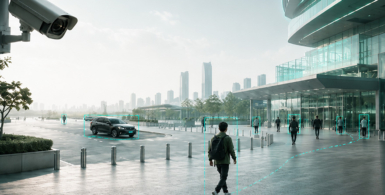
Camera systems generate enormous amounts of footage every single day. Traditional Video AI Analytics helps automatically recognize people, vehicles, objects, and specific events within that footage. A system can, for example, flag when someone enters a restricted area, when a vehicle drives against traffic flow, or when an object has been left unattended.
That delivers valuable information. Yet these often remain isolated detections that an operator has to combine and interpret themselves. Video Language Models, also known as Vision Language Models, add a new layer to this process. They can not only recognize what appears on screen, but also identify connections between objects, movements, and events. They can then describe that information in plain language. Want to learn more about exactly what Video Language Models are? Read our in-depth article on the topic.
As a result, video analysis is shifting from the question “what was detected?” to “what is actually happening here?”
Traditional Video AI Analytics is typically developed for clearly defined tasks. A model might, for instance, be trained to recognize people, cars, bags, smoke, fire, or weapons.
Rules can then be linked to these detections, such as:
These specialized models are particularly well suited for continuous monitoring. They can analyze large numbers of camera streams and respond quickly when a predefined situation arises.
The limitation is that the various detections are often presented separately. A camera might, for example, establish that a person and a bag are present. A short while later, it detects that the person leaves the area.
The operator then has to determine for themselves whether these observations are related.

A Video Language Model doesn’t just analyze individual objects or video frames. It also looks at the sequence in which events take place.
This involves combining several forms of artificial intelligence:
Suppose a camera registers the following separate events:
Traditional video analysis can detect these elements individually. A Video Language Model can turn that into a coherent description:
A person sets down a bag next to a pillar and then leaves the area without taking the bag with them.
That description gives the operator faster insight into what may have happened.
This doesn’t mean a VLM understands a situation the way a human does. The model has no consciousness and doesn’t know the intent of the person involved. It recognizes patterns and relationships in the footage and translates these into a probable description.
An important change is that users are no longer solely dependent on preconfigured filters and detection rules.
With traditional video search, an operator might select, for example:
That’s already much faster than manually reviewing camera footage. Even so, the user needs to know exactly which characteristics are available and which filters to apply.
With a Video Language Model, a search query can eventually be formulated much more naturally. For example:
The user describes the situation they’re looking for. The system then tries to match that description to relevant video footage.
This makes advanced video analysis more accessible to operators who lack technical knowledge of AI models, metadata, or search filters.

Video Language Models are unlikely to fully replace specialized Video AI Analytics.
Specific detection models remain valuable for situations where speed, consistency, and scalability matter most. Think of real-time perimeter detection, license plate recognition, people counting, or detecting smoke and fire.
A specialized model is developed to perform one specific task as efficiently as possible.
VLMs are particularly interesting when:
The most logical development is therefore a combination of both techniques.
Traditional analytics detect and classify objects and events. A Video Language Model then helps connect, describe, and make this information searchable.
You could say that traditional Video AI forms the eyes, while a VLM adds language and context.
The possibilities are significant, but Video Language Models also have limitations.
A VLM can describe a situation incorrectly or incompletely. For important incidents, the operator must therefore always verify the original footage. An AI description is a tool, not a definitive finding.
A system can recognize that someone sets down a bag and walks away. It cannot determine with certainty why someone does this.
The difference between an innocent situation and a security risk often requires human judgment.
Poor lighting, low resolution, an unfavorable camera angle, or partial obstruction of the view all affect the quality of the analysis.
Even advanced AI cannot reliably interpret what isn’t sufficiently visible.
Organizations need to clearly determine:
Deploying a VLM doesn’t change an organization’s responsibility to handle camera footage and personal data with care.
Within the Vaidio platform, Video Language Models can be combined with existing Video AI Analytics. This creates a hybrid approach. Specialized analytics can continuously detect people, vehicles, objects, and events. A VLM can then help describe more complex situations or search footage using natural language.
Among other things, organizations can:
An important starting point is that this doesn’t automatically require an entirely new camera system. The intelligence can be added to an existing video environment, depending on the cameras, infrastructure, and integrations already in place.
The challenge of modern camera surveillance isn’t a shortage of available footage. The problem is that organizations collect far more video data than people can manually review and assess. Traditional Video AI Analytics already brought an important change here. Cameras could not only record, but also automatically flag people, objects, and events.
Video Language Models take the next step. They connect individual observations with time, context, and language. This makes it possible to search camera footage more naturally and understand more quickly which events deserve attention.
The camera itself may not change. But the way organizations extract information from camera footage is changing fundamentally. Video is shifting steadily from passive recording to an active source of information and decision support.