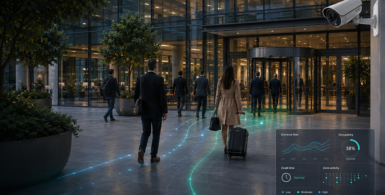
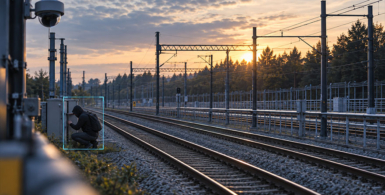
Critical infrastructure needs more than cameras that record
Recent incidents in the Netherlands and Germany once again show how vulnerable critical infrastructure can be. And they raise an…

It is often a sensitive subject: the deployment of facial recognition. Today, this technology offers countless opportunities within safety & security. It is also one of the 35+ Video AI Analytics offered by the Vaidio platform. But when can you deploy this technology? And in what areas can it all be deployed? In this article, we take a closer look at that.
Facial recognition is a technology that uses biometrics to identify or verify a person based on his or her face. The process starts by capturing an image of a face, often through a camera. Software then analyses the image by identifying and measuring certain unique features of the face, such as the distance between the eyes, the shape of the cheekbones and the contour of the lips. These features are converted into a unique code, known as a “”faceprint””.
The faceprint is then compared with a database of stored faceprints to find a match. Depending on the application, the technology can be used to identify a person (who is this person?) or to verify (is this person who he or she claims to be?). The whole process can take place in real-time, which makes face recognition particularly suitable for applications in security and access control.
Facial recognition is a powerful tool, but also a sensitive issue, especially when it comes to privacy. The technology works by scanning faces and comparing them to a database, which can lead to concerns about data protection and the invasion of personal privacy. It is therefore crucial to be clear about when and how facial recognition may be used.
It is essential to know when facial recognition can be used legally. The laws and regulations surrounding the use of facial recognition vary by region and country. Organizations must comply with the General Data Protection Regulation (AVG/GDPR) and other relevant legislation to ensure individuals’ rights are protected.
Before facial recognition is deployed, it is crucial to conduct a thorough Data Protection Impact Assessment (DPIA). A DPIA helps identify and minimize privacy risks. It provides a structured way to assess whether the benefits of using facial recognition outweigh the potential drawbacks and risks. This is often a mandatory step to ensure that the implementation of facial recognition technology is done responsibly and ethically.
>> Learn more about the use of camera technology and the AVG/GDPR legislation, in this article<<
Facial recognition can be used for various purposes, the most common of which is access control. Namely, it is possible to open doors or gates automatically on the basis of facial recognition. This is done on the basis of integration with an I/O module. This streamlines the process of access management, makes it more efficient and reduces the risk of unauthorized access. Employees and visitors can quickly and easily access buildings without physical keys or access passes, increasing both security and usability.
>> Want to learn more about exactly how an I/O integration works? Then read this article. <<
As an application, facial recognition also significantly increases security. By identifying suspicious persons and taking immediate action, potential threats can be dealt with faster and more effectively. This can range from identifying wanted criminals in public areas to recognising unauthorised persons in secure locations.
In addition, there are numerous situations where facial recognition can be used to improve safety and security:
Airports: facial recognition can help identify passengers quickly and accurately, making check-in and security checks more efficient.
Stadiums and events: security personnel can use facial recognition to identify suspicious persons and respond quickly to potential threats.
Business areas: access control can be automated, allowing only authorised personnel to access certain areas.
Openbare veiligheid: veiligheidsdiensten kunnen gezichtsherkenning gebruiken om gezochte personen te identificeren en criminele activiteiten te voorkomen.
Care homes: based on facial recognition, it is possible to set up living circles for residents with dementia. Are they standing in front of a door they should not pass through? Then the door locks. Is a staff member standing in front of the door? Then it opens.
Facial recognition offers enormous potential for improving safety and security, provided it is used responsibly and in compliance with laws and regulations. It is a powerful tool for access control, increasing security and efficiently managing security processes. By conducting a thorough DPIA and consciously addressing privacy concerns, organisations can maximise the benefits of facial recognition technology while respecting and protecting the rights of individuals.
Want to know more about the potential of facial recognition for your organisation? Check out the product pagea or Contact one of our specialists. They will be happy to help you.