Vaidio now supports SIA DC-09 for direct alarm transmission to control rooms
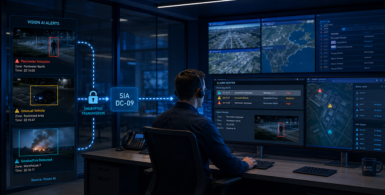
VAIBS now supports the SIA DC-09 protocol within Vaidio. This allows alarm notifications generated by the Vision AI platform to…

Video Analytics is an essential tool for monitoring real-time video streams and forensic examination of stored video footage. It helps analyze events or particular patterns of behavior in a particular area. Insights derived from this video analytics provide several benefits. One of the most important of these is that these insights can help optimize business processes or security protocols.
Not surprisingly, Video Analytics is increasingly being used by various (government) organizations in different industries. In fact, research firm MarketsandMarkets describes in a report that the global market for video analytics will grow at an annual rate of 20.4% between 2021 and 2026. The fact that Video Analytics can be used more and more broadly as an application is the driving force behind this growth. This is accelerating developments. A number of important trends also play a role in this, which are expected to determine the future of video analytics. In this blog, we will briefly discuss seven of them.
In recent years, Artificial Intelligence (AI for short) has become one of the most widely used technologies within software development. Here it is mainly applied to automate tasks that normally require human intelligence. So too within video analytics. In fact, AI within video analysis makes it possible to automatically monitor enormous amounts of footage. The detection of objects, people, events or behavior patterns no longer needs to be done manually. This saves an enormous amount of time.
Computer Vision, a field within computer science aimed at detecting objects and people on images and video, has been around for a long time. Often these are point solutions and therefore developed very specifically for one particular product. Accuracy is often a challenge with these solutions. With the development of Deep Learning and Machine Learning, the accuracy and speed with which video analysis systems can analyze data have improved dramatically. This development is also expected to drive the application of AI within Video Analytics in various industries.
Even within the retail sector, we are increasingly seeing the use of smart video surveillance technologies to prevent theft, for example. With smart video analysis, suspicious behavior can be detected automatically. This enables security to react faster to what is actually happening in a store. This technology is only becoming more accurate through Deep Learning and Machine Learning. As a result, store security is becoming more effective and efficient.
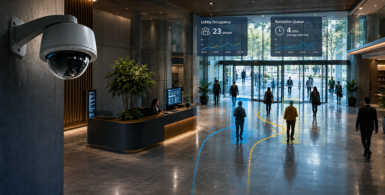
Obviously, the above can also be used to secure buildings, waters or land. And this is also done a lot these days. Intrusion detection and detection of deviant/suspicious behavior are common applications whose demand is only increasing. Again, the ever-increasing accuracy ensures a decrease in erroneously generated reports and a more efficient deployment of security teams. Something that is hugely welcome in times of labor shortages.
Drones have become enormously popular among consumers in recent years, but also within video surveillance this tool is slowly becoming more and more common. Especially for very large and/or difficult to reach areas. Consider, for example, large bridges or locks that need to be checked for needed maintenance or areas where environmental crimes often occur. The combination of Video Analytics and drone imagery offers enormous potential. This will ensure that this technology will be used more and more in the coming years.
But not only within security does Video Analytics play an increasingly important role. Demand is also increasing in the area of (personal) health and safety. Face masks, spacing, traps, people in hazardous environments or personal protective equipment: AI-based Video Analytics can detect it all. More and more companies are deploying one or more previous applications in the workplace to ensure employee safety. Because the system is always on and automatically detects, additional manpower for security or monitoring is not needed.
The deployment of smart video analytics naturally yields a tremendous amount of data. Increasingly, that data is being used to gain insights and predict future scenarios. This, to optimize business processes, improve security protocols or better adapt services to demand. Whether within retail, healthcare, manufacturing or logistics: the generic nature of Video Analytics makes it widely deployable and applicable. Even outside the business world. For example, there are already numerous cities using video analytics to make infrastructure safer or security services using data from smart video surveillance to stop crime. Think of using LPR (license plate recognition) or using metadata from video images to predict criminal behavior. This will only increase in the coming years.
Finally, we are also increasingly seeing that that video analytics is not limited to video feeds alone. Indeed, integrations with other software systems, such as PSIM or access control systems, are taking off. After all, you can do a lot with the data that is generated. Even within other systems. Is smoke or fire detected? Then the sprinklers and alarm system must be triggered. Fire shots registered? Create an automatic notification for the police! Another example is combining RFID with Video AI Analytics to create smart parking solutions that can track occupancy in real time and direct drivers to their spots. So, as these examples show, the integration possibilities are endless.
Having covered the various trends, it is clear that Video Analytics will play an increasingly important role within various fields. The above trends will be a driver in this. The possibilities of smart video analytics are, as mentioned, enormously broad.
Wondering what Video Analytics can do for your business? Please feel free to contact us. At VAIBS, we help organizations extract valuable information from video footage and turn it into visual, actionable data. We do this with Video AI Analytics through our product Vaidio: the Video-AI Analytics platform to which tens of thousands of cameras worldwide are connected every day to detect objects, people, anomalies and patterns. And it does so with unprecedented speed and accuracy. The platform integrates with 25+ leading VMS systems in the market and works with virtually every IP camera available.