Webinar // Follow the Flow: Realtime Tracking Without Privacy Risks
When dealing with an incident, suspicious situation or missing person, acting quickly and effectively is critical. Which people or vehicles…
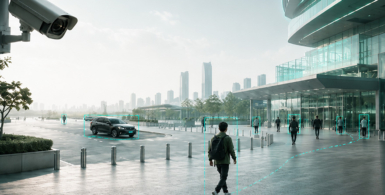

In incidents, suspicious situations or missing person cases, every second counts. Operators, security teams and investigative services need to quickly understand what happened, which persons or vehicles were involved, and which route they took.
In practice, much of this information is already captured in video footage. However, manually searching through video material is often time-consuming. Especially when a person or vehicle moves across multiple cameras, locations or zones. What starts as a single search query can quickly turn into hours of reviewing, comparing and reconstructing footage.
With Vision AI, this can be done differently. But what exactly is Vision AI?
Traditional camera systems mainly record what happens. The footage is available, but the interpretation is still largely done by people. Operators need to search, assess and connect information from different camera views themselves.
Vision AI adds an intelligent layer to this process. Existing camera footage is analysed for persons, vehicles, objects, movements and characteristics. As a result, video becomes more than just a recording after the fact. It becomes a source of real-time insight.
Importantly, this technology works with existing CCTV and VMS systems. Organisations do not need to replace their entire camera network. Vision AI makes existing cameras smarter by automatically analysing video and making relevant information available faster.
Cross Camera Tracking is an application within Vision AI that allows persons and vehicles to be followed across multiple cameras. Not by identifying someone based on biometric data, but by analysing visual characteristics. Think of clothing colour, object type, vehicle colour or vehicle category.
Based on these characteristics, the system can help find a target object across multiple camera views. This makes it possible to understand where a person or vehicle came from, which route was taken and where the object may have gone.
For operators, this means they can act much faster. Instead of manually searching through hours of video footage, they can search more specifically based on relevant characteristics and movements.
Tracking technology often raises immediate questions about privacy. And rightly so. Especially in public spaces, healthcare environments, business parks, logistics sites or municipal camera networks, personal data and video footage must be handled with care.
The key difference with Cross Camera Tracking is that it is not about identifying a person. It does not use facial recognition, fingerprints or other biometric data. The technology searches for visual similarities based on external characteristics, without determining who someone is.
This makes it an interesting alternative for organisations that want to search and respond faster, while maintaining control over privacy, compliance and the responsible use of AI. Cross Camera Tracking supports an important balance: faster insight during incidents, without deploying unnecessarily sensitive or privacy-invasive technology.
The practical impact can be significant. Imagine a suspicious person enters a site, moves past several buildings and eventually disappears from view. Without intelligent support, an operator must manually select cameras, compare timelines and review footage.
With Cross Camera Tracking, the search becomes much more focused. The system helps find the same target object on other cameras and visualises the route. This provides faster answers to questions such as:
This is valuable for control rooms, police districts, municipalities, hospitals, airports, logistics environments, industrial sites and other organisations with larger camera networks.

Vision AI does not replace the role of the operator. Instead, the technology supports operators in processing large volumes of video information. The system helps find relevant fragments, objects and movements faster, so people can make better-informed decisions.
This shifts the work from endless searching to focused assessment. Operators remain in control, but receive the right information much faster and at the right moment.