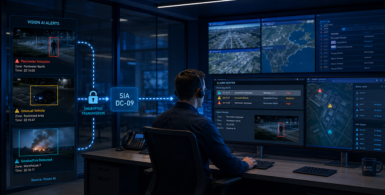
Vaidio now supports SIA DC-09 for direct alarm transmission to control rooms
VAIBS now supports the SIA DC-09 protocol within Vaidio. This allows alarm notifications generated by the Vision AI platform to…

A vehicle that quietly follows another vehicle onto a secured site, or a person holding the door open for an unauthorized individual. They seem like small, everyday moments. Yet this is exactly how unauthorized people gain access to buildings, sites, and critical environments. This phenomenon—tailgating or piggybacking—is one of the most underestimated security risks in access control. And traditional systems often don’t even register it. With Video AI Analytics (Vision AI), that changes. How? You’ll read it in this article.
Tailgating and piggybacking are very similar, but in practice there are subtle differences. The main distinction lies in the involvement of the authorized person.
Tailgating (following someone in):
This is a covert action. The intruder waits for a door to open and quickly slips in before it closes. The authorized person does not notice someone entering behind them.
Piggybacking (being let in):
This is often based on social manipulation (social engineering). For example, the intruder may ask someone to hold the door open, pretend they forgot their access badge, or claim their hands are full of boxes. The authorized person then unknowingly—but actively—grants access.
Both methods are used to bypass physical security and lead to unauthorized access, creating risks such as theft or data breaches.
To prevent tailgating and piggybacking, various (mostly traditional) solutions are available. Think of access control systems with:
These systems check who is authorized, but not what actually happens. An access card grants entry to the person it belongs to—but in practice it could be someone else using that card, or a second unauthorized person may follow closely behind. Without additional control, this often goes unnoticed.
Incidents are usually discovered only afterward, for example by reviewing CCTV footage. By then, it is often too late. In many cases, this creates a significant blind spot.
To address that blind spot, Video AI Analytics—also known as Vision AI—offers a solution. Where traditional cameras mainly record, Vision AI adds an extra layer of intelligence. Video footage is no longer only stored, but actively analyzed.
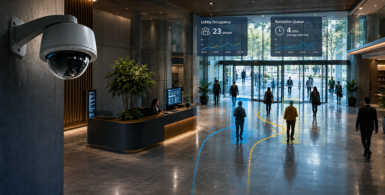
With AI, cameras can automatically recognize what is happening in the scene. People and vehicles are detected, tracked, and counted. The system understands where an access point is located and how many objects pass through it.
This creates a fundamental difference in information.
Not only:
“a credential was used”
But:
“two people entered while only one was authorized”
This makes it possible to identify anomalies immediately, rather than only discovering them afterward.
So how does this technology work? To use Vision AI for detecting tailgating and/or piggybacking, an (already existing) camera should be aimed at a door, turnstile, or barrier. The Vision AI software continuously analyzes the video stream and automatically detects people or vehicles.
By defining virtual zones or lines, the system knows exactly where an entry passage takes place. Each passage is counted and linked to logic: how many objects are allowed through at once?
When multiple people or vehicles pass through the same opening almost simultaneously—while only one is permitted—the system identifies this as an anomaly. At that moment, it can immediately send an alert to the control room, store a video clip, or even trigger an automated action, such as blocking the next passage.
This transforms video from passive observation into real-time security.
Although tailgating and piggybacking are often associated with office buildings, the issue occurs in many other environments. In industrial and logistics settings, unauthorized vehicles can enter a site unnoticed. In hospitals and healthcare facilities, controlled access to specific areas is crucial for safety and privacy. Within critical infrastructure—such as power plants, data centers, or water treatment facilities—one unauthorized person can already create major risks.
In all these situations, the same principle applies: access rights alone are not enough. What matters is what actually happens at the entrance. Vision AI makes that behavior visible.
The interesting part is that Video AI not only helps prevent incidents, but also delivers operational benefits. Because each passage is automatically logged and linked to video evidence, it creates a clear audit trail. When questions or incidents arise, it becomes immediately visible what happened—without spending hours searching through footage. In addition, it reduces the number of manual checks and lowers the workload in control rooms.
It also supports compliance. Organizations can demonstrate that access procedures are actually being followed, which is increasingly important for regulations and certifications. Access control therefore becomes not only safer, but also smarter and more efficient.
Access control will always be about identity and authorization. But in a world where risks are becoming more complex, that alone is no longer enough. Organizations want to know not only who has access, but also be sure that procedures are truly being followed. By adding Vision AI to existing cameras, that extra assurance becomes possible. The system sees what people miss and intervenes when necessary—making it much harder to simply “walk in behind someone else.”