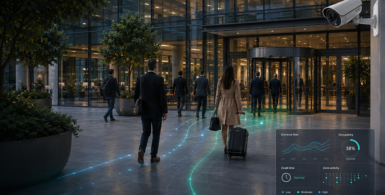
Critical infrastructure needs more than cameras that record
Recent incidents in the Netherlands and Germany once again show how vulnerable critical infrastructure can be. And they raise an…


Searching through hours of footage manually can be quite a challenge. Especially when it comes to (public) places where there is a lot of movement and people and/or vehicles congregate. It is then a labour-intensive job, with a chance of missing something important. The rise of AI makes it possible to perform forensic imaging more efficiently and effectively using AI meta tagging. How exactly that works, we explain in this article.
To get a good idea of what video meta tagging is, it is good to know exactly what it is and how this technique works.
AI meta tagging is the process of using artificial intelligence to automatically analyse video footage and provide it with information. If we parse the word ‘meta tagging’, ‘meta’ (metadata) stands for the piece of information, ‘tagging’ stands for assigning that information to objects, people, vehicles, patterns, behaviours and anything else seen on the footage. Assigning metadata to imagery provides the context needed to properly understand what is actually happening. So basically, meta tagging involves labelling and categorising all things. These labels are stored and linked to the recorded footage.
For recognising people, vehicles, objects, etc., AI algorithms are used, as mentioned above. These algorithms can be trained, by learning an awful lot of real-world examples. The more examples are learnt, the better trained an algorithm is, the more accurate and better it will recognise and detect things.
Analysing and labelling imagery, provides several advantages when it comes to forensic image examination. Below is a brief overview:
Automatic image analysis
In AI meta tagging, imagery is analysed automatically, as mentioned above. Hours of footage is processed using trained AI models. This way, manually going through footage is not necessary. Everything is done for you.
Easy and fast retrieval
Once all the footage has been processed, everything that occurred is labelled. This makes it possible to use smart filters to easily search, for example, for a person or vehicle matching a particular description. Within seconds, all results matching the search query will then come up. This saves an awful lot of time, which can be very important when searching for suspicious persons/vehicles or a missing child. In such cases, every second counts.
Real-time alerting
Meta tagging is thus powerful when combined with historical imagery, but also works very well when combined with live imagery. When this process takes place based on live imagery, it can also be linked to alert rules. Is something detected and thus labelled unwanted? Then an alert rule is automatically triggered that performs an action. For example: sending a text message or generating a notification within a system an operator uses. Wondering what this technology can do for an incident room, for example? Then read this article.
After reading this article wondering what this technology can do in practice? Contact one of our specialists. They will be happy to help you further.
We are VAIBS. An ambitious and energetic company from the Netherlands that helps organisations turn information from video images into actionable data. We do this by making every (existing) IP camera smart using Video Artificial Intelligence. To do this, we use Vaidio: the Video AI Analytics platform to which tens of thousands of cameras worldwide are connected every day to detect objects, people, anomalies and patterns. And it does so with unprecedented speed and accuracy. Want to know more about Vaidio? Then take a look at the product page or view the brochure.