


How to Turn Visual Data into a Strategic AI Advantage
AI is developing at an incredible pace. New models, copilots and agents are becoming increasingly powerful. Almost every organisation is…

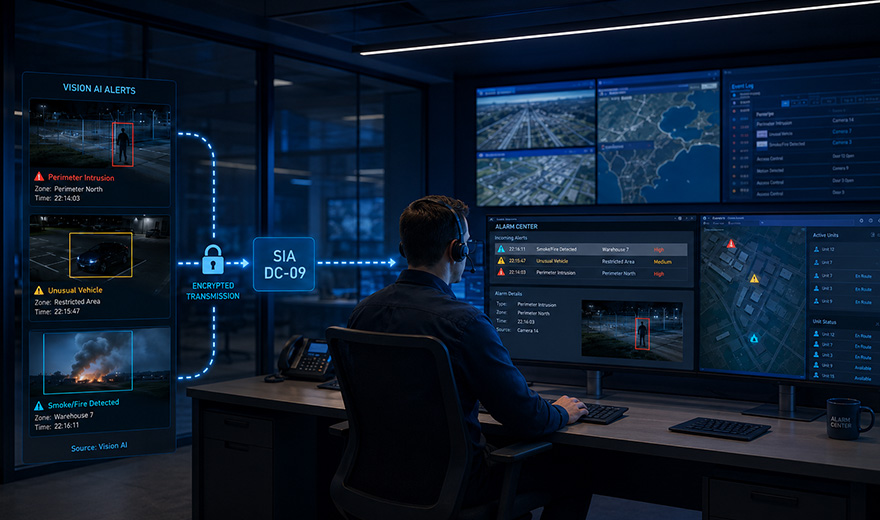
VAIBS now supports the SIA DC-09 protocol within Vaidio. This allows alarm notifications generated by the Vision AI platform to be transmitted directly to an alarm receiving centre or security control room.
Events detected by Vaidio can therefore be integrated directly into existing alarm response processes. Examples include a person entering a secured perimeter, a vehicle remaining stationary in an unusual location for an extended period, or the detection of smoke and fire.
The operator receives the notification within the familiar monitoring environment and can assess and handle the alarm in accordance with existing procedures.
SIA DC-09 is an international standard for transmitting alarm events over an IP network from a secured location to a central monitoring station.
The protocol enables different security systems and alarm receivers to exchange information in a standardised way. A notification may, for example, include information about:
SIA DC-09 was developed to support open and interoperable alarm transmission over IP. As a result, monitoring centres do not need to implement a separate alarm reception method for every individual technology provider.
Vaidio analyses live and recorded camera footage using Vision AI. As soon as the platform detects a predefined event, it can automatically generate an alarm notification.
Thanks to SIA DC-09 support, this notification can then be transmitted to a compatible receiver within the monitoring centre.
A typical process may look as follows:
The Vision AI detection therefore becomes part of the regular alarm response process, without requiring operators to continuously monitor separate dashboards or camera feeds.
The integration of Vaidio with SIA DC-09 makes it easier to incorporate Vision AI into established security operations.
Key benefits include:
By combining intelligent video analysis with a widely adopted alarm transmission standard, organisations can add Vision AI to their existing security infrastructure without unnecessarily changing established control-room processes.


