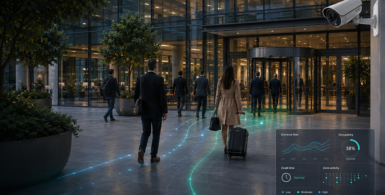
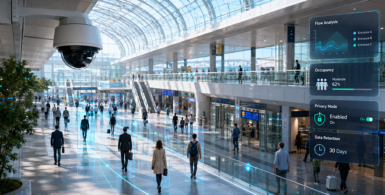
Webinar // Follow the Flow: Realtime Tracking Without Privacy Risks
When dealing with an incident, suspicious situation or missing person, acting quickly and effectively is critical. Which people or vehicles…
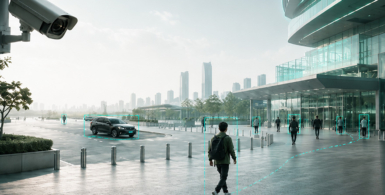

Within the control room world, innovation plays an important role. On the one hand to increase the quality of services, and on the other to counter challenges such as staff shortages. Deployment of smart tools is therefore something that is becoming increasingly common. Video AI Analytics is an example of this. How this technology can support the control room, you can read in this article.
Video AI Analytics, also known as video intelligence, is the application of artificial intelligence (AI) and machine learning algorithms to analyse and understand video footage. It is like having a superpowered video analyst who automatically views footage, interprets it and filters and reports on valuable insights or undesirable events. Video AI Analytics can be deployed in conjunction with IP cameras as well as historical footage.
How can this technology play a supporting role in the control room? Below, we list this for you.
Monitoring hundreds of images simultaneously is a labour-intensive and error-prone task. Video AI Analytics can play an important supporting role in this area. As mentioned, this technology casts itself as a superpowered video analyst, automatically analysing real-time video footage.
When the smart algorithms detect unwanted or threatening situations, the dispatcher is immediately alerted. Monotonous looking through images where nothing happens is therefore a thing of the past. After all, the operator only has to assess whether something should be done with the report. Because detection takes place on the basis of real-time images, you avoid having to act (too late) only afterwards, when something happens to be missed during manual monitoring.
Today, there are many different systems or technologies available to secure sites, areas, buildings and objects. Many of these systems consist of ‘smart’ instruments that detect things like movement, to then issue a notification. However, external factors such as wind, rain, reflection of light or movement of small or medium-sized animals are major interferers here. Many of these smart instruments are not developed intelligently enough to distinguish the movement of an animal or raindrops from a person. The result? An awful lot of false alarms which is distracting for security staff and also time-consuming. Alarm fatigue is then a logical consequence.
Not desirable, of course. After all, as a switchboard operator, you only want to pay attention to reports that matter. Since good control room staff are already scarce, you of course want the have the quality of those calls to be good.
This is exactly the area where Video AI Analytics plays an important role. By deploying AI and Deep Learning, security systems (equipped with a camera network, of course) are able to detect, recognise and distinguish between objects, people, vehicles and patterns. This ensures that the systems issue a notification only when it is really necessary and not when a cat walks by or a rubbish bag blows over the fence. The number of false or unwanted alarms is therefore drastically reduced. Security personnel therefore spend less time dealing with reports that do not matter.
Prevention is better than cure. A well-known proverb, which certainly applies in the world of safety & security. How nice would it be if you could prevent an incident based on a number of omens? This is something that is quite tricky if it has to be done manually for several video images at the same time. This is another area where Video AI Analytics can play an important role.
Indeed, it is possible to set up this technology so that the control room is notified when one or more examples are met. Examples include:
Has the incident already taken place? Even then, Video AI Analytics can support the control room. With this technology, it is also possible to automatically track suspicious persons or vehicles based on certain and/or external characteristics. In this way, you get lightning-fast insights into where a person or vehicle is and exactly what route they have taken. This not only provides valuable information for ongoing investigations, but also enables emergency services to respond quickly and locate suspects in emergency situations.
Not only in terms of real-time monitoring can Video AI Analytics support the control room. It can also play an important role when it comes to historical footage. Because just like monitoring live footage, searching through historical footage is labour-intensive and error-prone.
With Video AI Analytics, manual searches are no longer necessary. The software allows dispatchers or other users to search easily and quickly via handy filters. This way, you can find the desired clip with that one person, vehicle or object in no time (seconds). This saves an enormous amount of time and directly contributes to a more efficient process.
All in all, we can therefore say that with Video AI Analytics, the control room gains an additional dispatcher, working 24/7. Both in terms of real-time monitoring and searching historical footage. Wondering what this technology can do for your organisation? Then contact with one of our specialists or take a look at the product page.
Would you like to see what Vaidio can do for control rooms? Next week, we will be present at eRIC 2024 at Vliegveld Twenthe in Enschede. For two days, this is the connection platform for security professionals, knowledge institutes and suppliers of vehicles, protective clothing and equipment, robotic technology and 3D exercise and training applications, specialist support teams, connections and information provision. eRIC shows state-of-the-art products and services across the entire breadth of the security domain.
At our stand, we will show what Vaidio can do within the control room and exactly how it works. Several control room partners will also be present to share their experiences with the Vaidio platform.
Registration is still free and can be done by clicking on this link. Looking forward to seeing you next week!