Webinar // Follow the Flow: Realtime Tracking Without Privacy Risks
When dealing with an incident, suspicious situation or missing person, acting quickly and effectively is critical. Which people or vehicles…
Recent incidents in the Netherlands and Germany once again show how vulnerable critical infrastructure can be. And they raise an important question: are we using cameras simply to record what happened, or can we use them to recognise suspicious activity while it is happening?
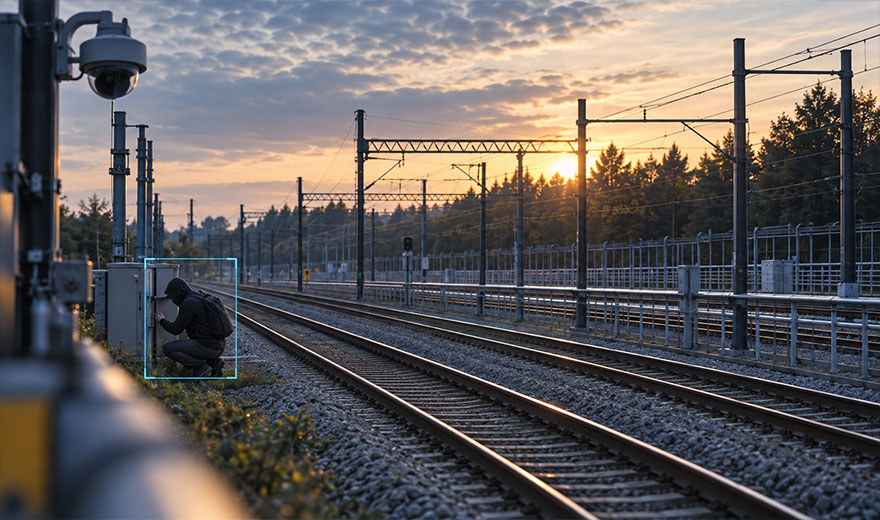
On September 15, railway traffic across large parts of the Netherlands was disrupted after materials were deliberately attached to railway infrastructure. ProRail reported faults at at least twenty different locations. While affected sections of railway could be identified, the exact locations could not, requiring sections of track to be physically inspected.
Germany has also experienced several recent attacks and attempted attacks on its electricity infrastructure. High-voltage infrastructure and substations were targeted in multiple states, with incidents temporarily taking power generation units offline. German police later detained a suspect who was reportedly carrying explosive devices.
Different incidents, different circumstances. But they demonstrate the same challenge.
Critical infrastructure can cover enormous areas. Railways stretch for thousands of kilometres. Energy infrastructure consists of substations, power lines and facilities spread across entire regions. Ports, airports, industrial sites and other essential facilities face similar challenges. It is impossible for security operators to continuously watch every camera and recognise every situation that deserves attention.
CCTV already plays an important role in protecting critical infrastructure. But in many environments, cameras still primarily serve as a recording system. When something happens, footage is reviewed afterwards to determine what took place. Modern Vision AI can change that.
Instead of requiring an operator to continuously watch every video stream, AI can analyse existing camera footage and draw attention to situations that may require human verification. For example, when someone enters a restricted area or when a person remains close to critical equipment for an unusually long period of time. Or maybe when activity takes place at a location or time where nobody is expected to be.
The objective is not to automatically determine someone’s intentions. The technology identifies events and behaviour that match predefined security criteria and presents these to an operator for assessment. That distinction is important. The camera does not have to know who somebody is to recognise that something requires attention.
No technology can guarantee that every act of sabotage will be prevented. But technology can help reduce something that is crucial during an incident: the time between activity, detection and response.
Vision AI can continuously monitor selected areas and automatically generate an alert when predefined conditions are met. Instead of discovering an incident through its consequences, a security team may have an opportunity to identify suspicious activity while it is still taking place.
The operator remains in control. AI provides the signal and the visual context; a human determines what action should follow. This allows organisations to use their cameras much more proactively, without requiring security teams to continuously monitor hundreds or even thousands of individual video streams.
And when an incident has already happened? The value of Vision AI does not stop at real-time detection. Following an incident, investigators may need to understand who or what was present, how a person or vehicle arrived and where they went afterwards.
Traditionally, that can mean reviewing hours of footage across multiple cameras. With Vision AI, recorded footage can be searched using visual characteristics and AI-assisted Video Search. Cross Camera Tracking can help follow people or vehicles between cameras, while attributes such as clothing, vehicle type, colour or direction of movement can help narrow down relevant footage. All without facial recognition being required.
What previously meant manually reviewing large volumes of footage can become a much more focused search process.
For organisations responsible for critical infrastructure, the conversation around CCTV is therefore changing. It is no longer enough to ask: “Do we have this location on camera?”
There are additional questions worth asking: Do we know when something unusual happens there? Or: Can an operator be alerted quickly enough to assess it? And if an incident occurs, can we find the relevant footage without manually searching through hours of video?
Existing cameras can increasingly provide answers to all three questions. That changes CCTV from primarily a recording system into a much more active source of information. Because recording what happened remains important. But recognising what is happening can be even more valuable.
We recently discussed this subject in our webinar “The Role of Vision AI in Critical Infrastructure”, including practical examples of how existing camera infrastructure can be used for real-time detection, faster investigation and improved situational awareness. View the webinar by using the button below.