Data Sovereignty in Vision AI Goes Beyond Data Location
By Kasper van Kekem, CEO of VAIBS When I speak with organisations about Vision AI, data sovereignty is becoming an…

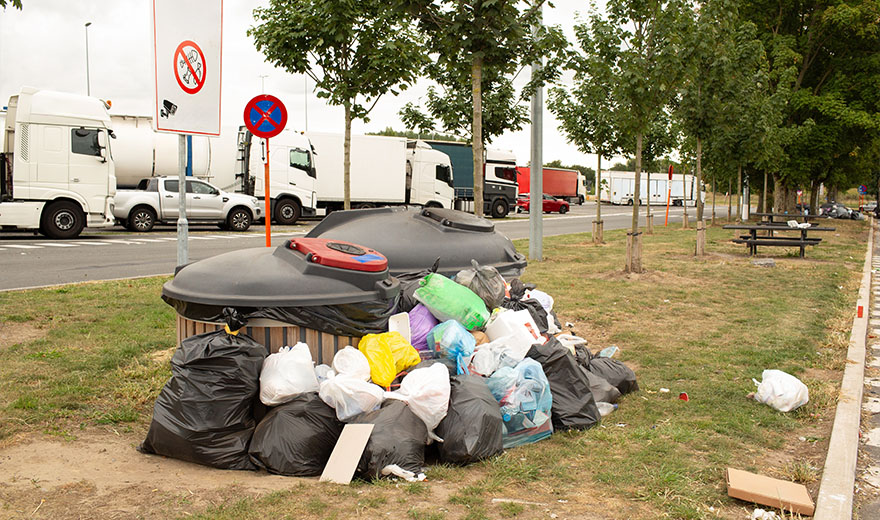
Illegal waste dumping is a persistent problem for many municipalities, business parks, housing associations, and site managers. Rubbish bags left beside underground containers, bulky waste on car parks, construction debris along access roads, or discarded appliances near collection points: it causes pollution, additional costs, and a sense of insecurity in the surrounding area.
The problem locations are often well known. There are sites where waste is routinely dumped or containers are consistently misused. Yet continuous monitoring is difficult to maintain. Manual inspections are time-consuming, camera footage is usually only reviewed after the fact, and by the time a report comes in, the culprit has long since disappeared.
Vision AI can make a real difference here. By equipping existing cameras with Video AI Analytics, organisations gain a system that automatically detects anomalies, triggers immediate alerts, and enables faster, more proactive responses.
Traditional camera surveillance is primarily reactive. A camera records what happens, but a staff member is always needed to watch footage live or search through recordings after an incident. When it comes to illegal waste dumping, this means that pollution is typically only discovered once someone files a report or an employee visits the site in person.
Vision AI changes that approach entirely. The technology automatically analyses camera footage and detects changes within the camera’s field of view. Think of a spot that was previously clear, where rubbish bags, boxes, mattresses, or other waste suddenly appear. As soon as such an anomaly is detected, an alert can be sent immediately to the right person, manager, or control room. Rather than discovering a dump hours later, organisations are notified almost instantly.
The technology works by recognising visual changes within a camera image. The software learns what the normal situation looks like at a given location — for example, a clean pavement beside a container or an empty zone next to a building. When a deviation occurs, the AI evaluates whether it is relevant.
Unlike conventional motion detection, the technology does not only look for movement — it assesses changes to the scene as a whole. The key question is: has something visibly changed that warrants attention? This makes the technology particularly well suited to situations where the exact object to be detected is not known in advance. Illegal dumping can involve all manner of items: rubbish bags, boxes, furniture, appliances, or building materials. Instead of training the system to recognise a single specific object, Vision AI looks for anomalies within the context of the image.
Settings can be tailored to each location: the area within the camera’s field of view to be monitored, the sensitivity of the detection, the minimum size of a change, and the delay before an alert is sent. This allows the technology to be configured for real-world conditions — strict at a known dumping hotspot, less sensitive at a location with a high level of normal activity.
A significant advantage is that organisations often do not need an entirely new infrastructure. Many municipalities and businesses already have cameras in strategic locations — at recycling centres, underground containers, business parks, car parks, or building entrances. With Vision AI, those existing cameras become more than passive recording devices: they become intelligent sensors that automatically analyse situations as they unfold.
This is especially valuable at locations where supervision is needed but permanent staffing is not practical. The AI only sends an alert when something genuinely changes that requires attention. This reduces the burden on enforcement officers and control rooms, freeing them to focus on situations that truly matter.
Vision AI can be deployed in several ways to tackle illegal dumping. At underground container sites, the camera detects when the surrounding area changes and waste appears. On business parks, an alarm can be triggered immediately when pallets or construction waste are left behind outside working hours. At recycling centres, Vision AI can flag when items are placed outside opening hours and help identify patterns: when does it happen most often, which locations are repeat offenders, and where is extra supervision or communication needed?
The same technology has broader applications too. Wherever an unwanted change in view is relevant — a blocked emergency exit, an obstructed route on a logistics site, a gate left open when it should be closed — Vision AI can provide support.
Detection is only valuable when the right action follows. An alert from Vision AI can be forwarded via a dashboard, email, app notification, or integration with an existing VMS or control room system. The alert immediately includes relevant information such as location, time, and camera image, so an operator does not need to spend hours reviewing footage before deciding what to do.
In the case of illegal waste dumping, this might mean notifying an enforcement officer, prompting a manager to check the location, or ensuring that footage is available for follow-up action.
Vision AI cannot prevent someone from attempting to dump waste. But it does help organisations find out faster what is happening, respond more effectively, and build up a structured understanding of problem locations. By extending existing cameras with Video AI Analytics, a scalable way to strengthen supervision is created — not by having more people stare at screens around the clock, but by letting technology automatically flag situations that deviate from normal. In this way, Vision AI contributes to cleaner, safer, and better-managed environments.