Data Sovereignty in Vision AI Goes Beyond Data Location
By Kasper van Kekem, CEO of VAIBS When I speak with organisations about Vision AI, data sovereignty is becoming an…

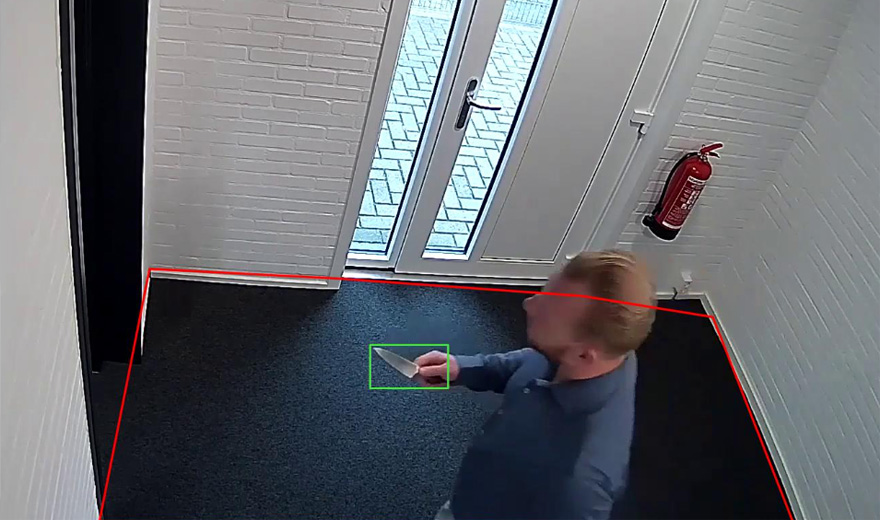
When a knife becomes visible in camera footage, every second counts. In public spaces, stations, shopping areas, schools, healthcare facilities and event venues, rapid detection can make the difference between timely intervention and reacting too late.
That is why VAIBS has further improved knife recognition within the Vaidio platform. For years, Vaidio has offered a powerful AI Engine for detecting weapons, including firearms and edged weapons. According to IPVM, Vaidio has consistently ranked among the best-rated solutions for weapon detection in video surveillance. With the latest improvement, knife recognition has been further refined specifically, as demand for this capability is unfortunately increasing across Europe.
But however valuable knife detection may be, it is only one part of a broader safety approach. Organizations that want to prevent or limit escalation should not only focus on the moment a weapon becomes visible. Often, earlier signals are already present that may indicate unrest, threat or a situation at risk of getting out of control.
Automatically detecting knives is an important application of Vision AI. Especially in environments where many people gather or where increased safety risks exist, it can help operators respond faster.
When the system detects a possible knife in the image, an alert can automatically be generated for the control room or security organization. The operator immediately receives the relevant footage and can assess what action is required. This shortens the time between detection and follow-up.
In situations where a weapon becomes visible, that time is extremely valuable. A knife can remain hidden for a long time: under clothing, in a bag, behind the body or simply outside the camera’s field of view. Once a knife becomes visible, it often comes down to seconds in which a fast and appropriate response is required.
That is why it is important that operators are not solely dependent on manual monitoring. In a busy or chaotic situation, Vision AI can help bring relevant images to the operator’s attention faster, so they immediately see where attention is needed.
Incident prevention does not only start at the moment a knife becomes visible. In many cases, that is already an advanced stage of escalation. Threatening situations often do not arise out of nowhere. Prior to an incident, there are often changes in behavior, movement or group dynamics. Think of people suddenly starting to run, a group rapidly gathering, bystanders abruptly moving away, or an unexpected increase in crowd density in a specific area. An emerging conflict, panic reaction or unusual movement can also be a reason to bring a situation to the operator’s attention sooner.
With Vision AI, existing cameras can be used to make these types of signals visible more quickly. Not by independently drawing conclusions about intent or behavior, but by highlighting unusual patterns for operators. This changes the role of camera surveillance: from passive monitoring or retrospective investigation to active detection and faster response.

In addition to knife detection, Vision AI can also support the recognition of broader escalation signals. Crowd management plays an important role in this. When the number of people in an area suddenly increases significantly, this may indicate group formation, congestion or the beginning of an unsafe situation. When people unexpectedly accelerate, run away or move against the normal flow of traffic, this may be a signal of panic, threat or an emergency.
Visual patterns that may indicate aggression or physical confrontation can also be noticed more quickly. Carefulness remains essential: Vision AI does not determine whether someone is aggressive and does not predict intent. The system signals situations that require attention, after which the operator assesses the context. It is precisely the combination of signals that makes the technology valuable. A possible knife detection, sudden panic, group formation or unusual movement may not always mean much in isolation. But together, these signals can provide the operator with relevant information to determine urgency and priority more quickly.
An important advantage of Vaidio is that these applications are not dependent on one specific camera brand or camera system. The platform is camera-independent and can be deployed on existing IP cameras. Organizations therefore do not need to completely replace their current camera network to make use of Video AI Analytics. In addition, Vaidio integrates with various VMS, NVR, PSIM and control room systems. As a result, alerts from knife detection, crowd management or other analytics can be incorporated into existing workflows.
Operators continue to work from the systems they already know, while Vision AI helps in the background to bring relevant situations to the forefront more quickly. This makes the technology applicable across a wide range of environments: from public safety and education to healthcare, transport, retail, events and critical infrastructure.
Vision AI does not replace people. The technology supports operators by making relevant situations visible faster and prioritizing footage that requires attention. This is important, because not every deviation is automatically an incident. A group of people gathering does not necessarily represent a risk. Someone running may simply be in a hurry. And a sudden movement does not automatically indicate panic.
The strength lies in support, context and faster assessment. Vision AI helps operators see earlier where attention is needed, so they can better assess, escalate and act. Even when a situation has already become chaotic, the system can continue to monitor. Where an operator cannot assess all camera images at once during panic or high pressure, Vision AI helps prioritize relevant signals and camera views more quickly.
The improved knife recognition within Vaidio Weapon Detection is a valuable step forward in recognizing direct threats faster. But the real strength emerges when this application becomes part of a broader approach. By combining knife detection with crowd management, anomaly detection and signals of possible escalation, a more complete picture is created of what is happening in an environment.
In this way, Vision AI not only helps recognize a knife when it becomes visible, but also helps detect earlier signals that may indicate a threatening situation. Because preventing escalation does not start with the incident itself. It starts with recognizing the signals that come before it.